

Angel Juicer: 10% with code LONGEVITY
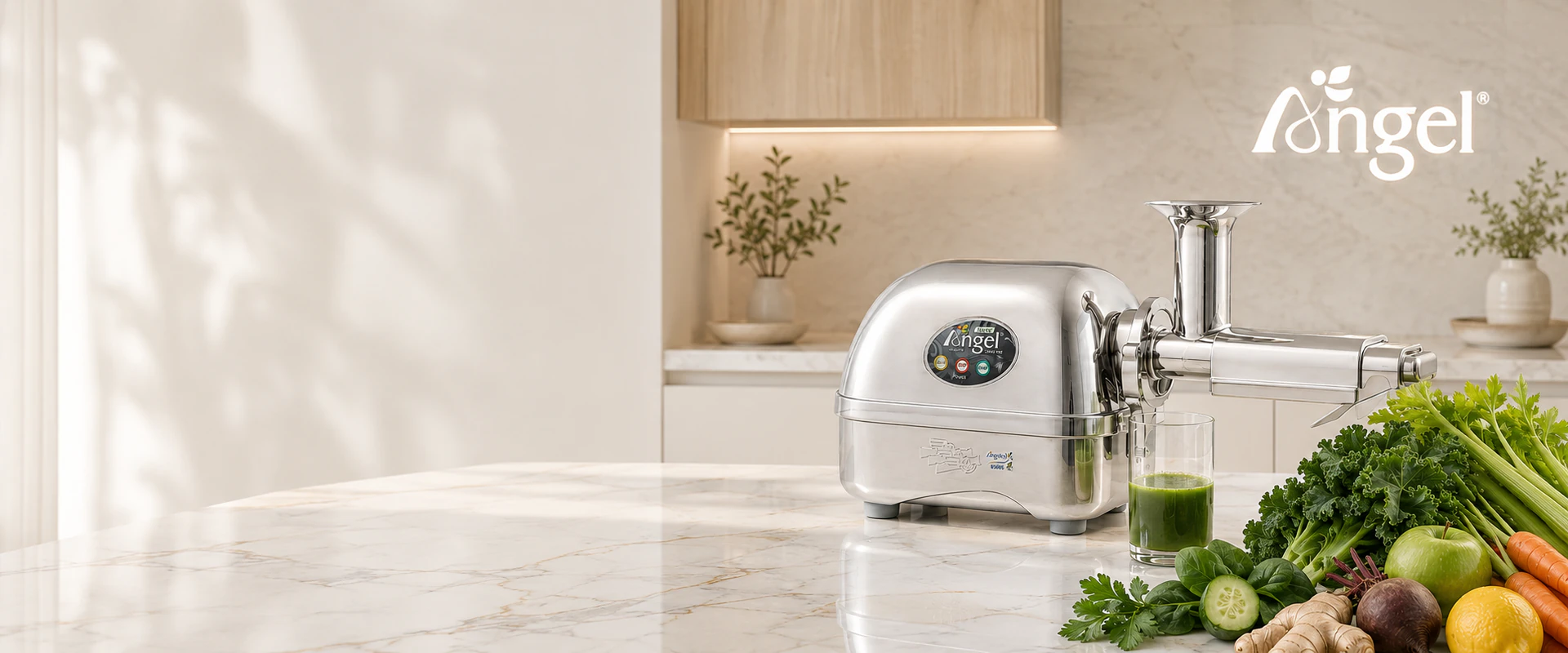
Horizontal twin-gear slow juicer in stainless steel, manufactured in Korea (manufacturer data). My way of getting more raw leafy greens into everyday life.
Disclosure: Our links are affiliate links. When you make a purchase, we receive a commission – at no additional cost to you. Learn more about our affiliate disclosure →
— Why a slow juicer fits longevity
Fresh vegetables as a longevity base
For me a slow juicer isn't a lifestyle gadget – it's a pragmatic tool. It helps me integrate significantly more variety of raw vegetables into my day than I would ever chew, especially bitter greens with high polyphenol density.
Bitter compounds & chlorophyll
Dandelion, celery, kale and parsley concentrate bitter compounds and chlorophyll – food groups strongly underrepresented in a modern diet.
Polyphenol density per session
500 g of raw vegetables yield 300–350 ml of juice. Per glass I get a polyphenol profile I can barely fit into a single chewed meal.
Low rpm
According to the manufacturer the twin-gear mechanism runs at roughly 82 rpm, so little heat is generated. Whether that produces a measurable difference in the nutrient content of the finished juice is not established.
— How twin-gear works
Why horizontal + two press augers?
The Angel Juicer uses two interlocking stainless steel press augers. Vegetables are processed in three stages – similar to how chewing would break them down.
1. Crushing
The two augers pull the vegetables in and mechanically break them down.
2. Grinding
Cell structure is disrupted, releasing intracellular nutrients.
3. Pressing
The juice is pressed through a fine stainless steel screen – the pulp is notably dry.
Result: higher juice yield per kilogram of produce and a noticeably wider taste range than single-auger or centrifugal juicers.
— Model overview
Angel Juicer 5500 vs. 7500 vs. 8500S
All three models share the same twin-gear principle at ~82 rpm and the same SUS 304 pressing chamber. What differs is the gear stage, automation and motor tuning – not the juice quality itself.
Angel Juicer 5500
- Motor & gearing
- Single-stage twin-gear system, ~82 rpm, standard induction motor without soft-start
- Features
- Base configuration, manual reverse switch only, no automatic overload protection
- Best for
- Occasional users doing 2–3 sessions per week, soft to medium-hard ingredients
- Price class
- High-end entry
- Honest note
- If you juice hard produce daily (celery stalks, kilos of carrots), the missing auto-reverse means more manual intervention. For occasional juicing the 5500 still saves ~20–30% vs. the 8500S.
Angel Juicer 7500
- Motor & gearing
- Three-stage twin-gear system (crushing + mixing + pressing), ~82 rpm, reinforced motor tuning
- Features
- Extended configuration, manual reverse, robust continuous use – but without the sensor-driven auto-reverse of the 8500S
- Best for
- Regular use, 4–6 sessions per week, also fibrous greens like kale or wheatgrass
- Price class
- High-end mid-range
- Honest note
- The sweet spot if you value the 3-stage gearing and higher leaf-yield but can live without auto-reverse. Typically €300–500 below the 8500S.
Angel Juicer 8500S
- Motor & gearing
- Three-stage twin-gear system with soft-start, ~82 rpm, revised motor with sensor-driven automatic reverse
- Features
- Automatic reverse against jams, improved motor cooling/ventilation, updated electronics, revised premium housing
- Best for
- Daily juicing, larger volumes, serious longevity routines with lots of kale, celery, ginger
- Price class
- Premium investment
- Honest note
- The premium is justified mainly by auto-reverse and cooling – both pay back over longevity and nerves under daily load. For two juices a week this is overkill.
If you'll actually use it daily, the 8500S is my best price-to-performance pick – mainly for the auto-reverse and improved cooling. All three models share the same SUS 304 pressing chamber; juice quality itself is indistinguishable in blind tests.
Juicer types compared
Slow juicers compared: twin-gear vs. single auger
Before picking a model, look at the mechanism. It determines yield, cleaning effort and price — and whether a machine fits your kitchen routine.
Twin-gear (Angel Juicer)
approx. 82 rpmStrength: Shreds and presses in two steps – high yield even with leafy greens, grasses and herbs.
Trade-off: Higher purchase price, more parts to clean.
Single auger (vertical/horizontal)
approx. 40–80 rpmStrength: Cheaper, quick to disassemble and clean, good for fruit and root vegetables.
Trade-off: More juice stays in the pulp with low-fibre leafy greens.
Centrifugal juicer
approx. 6,000–15,000 rpmStrength: Very fast, wide feed chute, inexpensive.
Trade-off: Introduces a lot of air, so the juice separates quickly and keeps less well.
All three Angel Juicer models (5500, 7500, 8500S) use the same stainless steel twin-gear press. The differences are speed settings, motor and convenience — not juice quality.
— Honest assessment
Where the Angel Juicer shines – and where it doesn't
What convinces me
- Very high juice yield per kilo, dry pulp
- Surgical stainless steel instead of plastic in the pressing chamber
- Very long service life, serious warranty terms
- Multifunctional: nut butters, sorbets, green juices from one machine
The honest downsides
- High purchase price – only pays off with regular use
- Cleaning takes ~10 minutes per session, you have to want it
- Significant counter space required
- Weight: not a machine you'll store in a cupboard daily
If you won't juice at least 2–3 times per week, the Angel Juicer isn't economical for you. But if you want to structurally bring raw vegetables into your day, you get a very durable tool.

— Personal
My Angel Juicer test
My kitchen runs an Angel Juicer 7500 alongside a Kuvings. My subjective impression from using both: the Angel does better with leafy greens. I have not measured it yet – so there is no number here.
What I will document – carried out identically on both machines:
- Cleaning time per session, timed
- Juice volume in millilitres from the same amount of produce, weighed
- Handling: prep, feeding, clogging
- Everyday practicality over several weeks
Until the measurements exist, there are no comparison figures here. Figures on material, gears and model differences on this page come from the manufacturer.
— Benefits
Why Angel Juicer
What sets Angel apart from other juicers.
Surgical stainless steel
Press chamber and augers made from SUS 304 – no plastic contact with the juice in the core zone.
True twin-gear principle
Two interlocking augers instead of a single-auger design – higher yield, especially on leafy greens.
Built for the long run
Housing, motor and drivetrain are designed for decades of use – Angel offers up to a 25-year warranty on core components.
High juice yield
The pulp comes out notably dry – more juice per kilo of produce than most slow juicers.
More than juicing
Nut butters, sorbets, frozen-fruit creams and green juices from one appliance – replaces several kitchen devices.
Manufactured in Korea
Produced at the manufacturer in Korea, no white-label. Long-term spare parts and support availability.
Angel Juicer discount code LONGEVITY
Direct access to all Angel Juicer models with 10% off.
🔬 Verified specs · ⚡ Redeem instantly · 🧬 Personally tested by Benedikt
* Affiliate link. No additional costs for you.
Join the Longevity Hackers inner circle
Every 1–2 weeks: Benedikt's latest biomarker results, new longevity protocols, fresh research — plus exclusive partner discounts before they go public.
- First-hand biomarker & self-test results
- New protocols & study breakdowns
- Exclusive partner codes first
Frequently asked questions about the Angel Juicer
Got another question? DM me on Instagram @bene__longevity.